How to Play
- Players
- 2
- Decks
- 50 main + 10 soul
- Starting life
- 10
- Souls per turn
- 2 (max 10)
- Opening hand
- 5 (1 mulligan)
- Win
- Opponent to 0 life
The play area
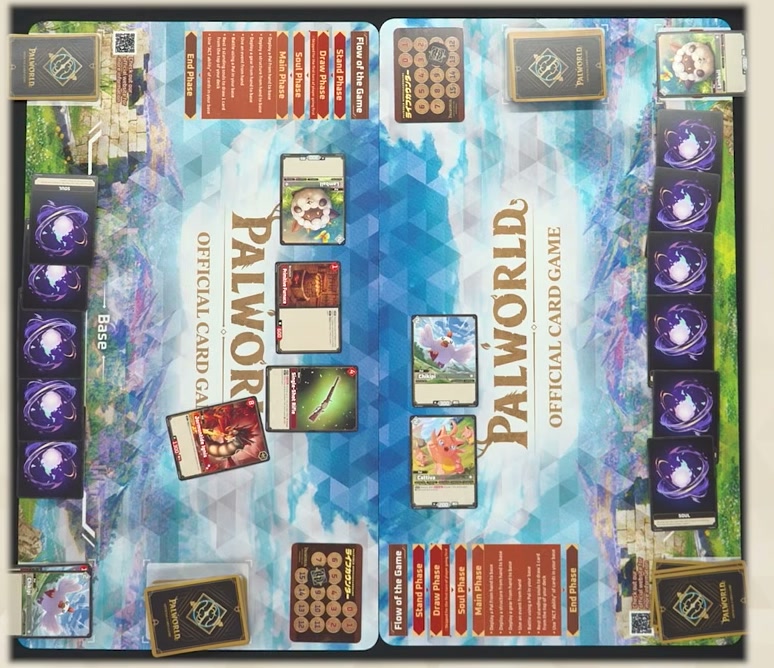
Each player controls one half of the mat. From the official video, the named zones are:
- Deck: your shuffled 50-card main deck. You draw from here and reveal from here during a damage check.
- Soul Deck: your separate pile of 10 Soul cards, your resource economy.
- Soul Area: where Souls you've drawn sit. You Rest (turn sideways) Souls here to pay costs.
- Base: your field. Pals, Structures, and Gear are played here.
- Graveyard: the discard pile for destroyed Pals, spent Events, and revealed damage-check cards.
- Flow of the Game: the printed phase track on the mat: Stand → Draw → Soul → Main → End.

Build your deck
Every legal deck is two separate piles:
- Main Deck: exactly 50 cards. Pals, Structures, Gear, and Events.
- Soul Deck: exactly 10 cards. Soul cards only, spent to deploy Pals and play other cards.
Construction limits:
- Up to two colors from Red, Blue, Green, and Purple. Colorless cards may always be included.
- 4 copies maximum of any one card name.
- 8 Lucky Pals maximum in the 50-card main deck.
- Both players start at 10 life; reduce your opponent to 0 to win.
“You may choose up to two colors from among Red, Blue, Green, and Purple to construct your deck. In addition to the colors you have chosen, construct a deck of 50 cards together with Colorless cards that can be used in any decks. You may only include up to 4 cards with the same card name.”· Bushiroad press release, BP01/TD0102 preorder announcement
Set up the game
The turn: five phases
Every turn follows the “Flow of the Game” printed on the mat:
- Stand Phase. Return all your Rested (sideways) cards, Pals and Souls alike, to Standing (upright).
- Draw Phase. Draw 1 card from your main deck.
- Soul Phase. Place 2 Souls from your Soul Deck face-up into your Soul Area. You add 2 per turn, up to a maximum of 10 total.
- Main Phase. Take actions in any order: deploy Pals / Structures / Gear, play Events, attack, activate abilities, and Assign Pals to Structures.
- End Phase. All damage marked on Pals and Structures is removed, and the turn passes.
Playing cards & paying with Souls
To play a Pal, Structure, Gear, or Event you pay its Cost, the number in the card's top-left corner. You pay by Resting that many Souls: rotate upright (Standing) Souls in your Soul Area to sideways (Rested).
In the video the player pays Cost 2 by Resting two Souls to deploy a Pal to their Base.
- Your Base holds a maximum of 5 Pals at any time.
- A newly deployed Pal can act immediately, so it can attack the same turn it's played (no summoning sickness).

Attacking a player & the Damage Check
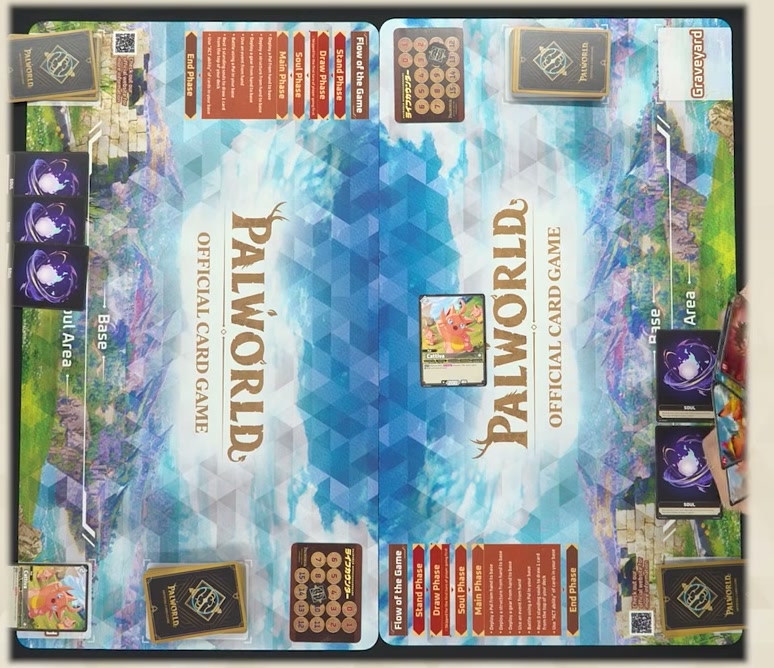
A Standing Pal can attack. When it does, it Rests. If it attacks the opposing player, it deals damage equal to its Strike value (the number on the lower-right of the card).
The attacked player then performs a Damage Check:
- Reveal cards from the top of your main deck, one card per point of damage (so Strike 1 reveals 1, Strike 2 reveals 2, and so on).
- If any revealed card is a Lucky Pal (marked with the Lucky sparkle icon in its upper-right), the damage is canceled and you lose no life from this attack.
- Otherwise you lose 1 life per point of damage. Revealed cards then go to the Graveyard.
Pal battles & blocking
Instead of the player, an attacker may target an opposing Pal, but only a Pal that is in the Rested (sideways) state. Standing Pals cannot be targeted by an attack (though they can block, see below).
When a Pal attacks a Pal, a battle happens, using each Pal's Power (the number in the bottom-left corner of the card):
- Both Pals deal damage equal to their Power to each other simultaneously.
- Any Pal that takes damage equal to or greater than its Power is destroyed and sent to the Graveyard.
- In the video, Power 300 vs Power 200: the 200 Pal is destroyed; the 300 Pal survives with 200 damage marked on it.
- Damage resets at the End Phase, so surviving Pals are fully healed for the next turn.
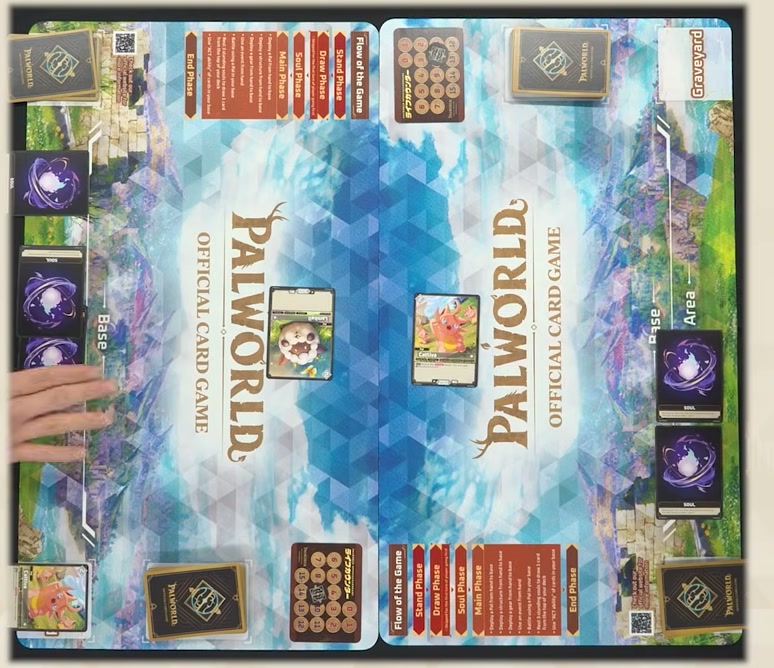
Blocking. A Standing Pal can block an incoming attack. To block, Rest the blocking Pal. This redirects the attack into a battle between the attacker and the blocker (resolved with Power, exactly as above).
Quick & interrupt
Some cards and abilities have the Quick keyword. When you are being attacked, you may play a Quick card at that moment, before the attack resolves.
The video demonstrates a Quick card with Interruptibility, played by either spending 1 Soul or discarding 1 card from your hand. A successful interrupt makes the opponent's attack fail: a failed attack ends immediately with no damage and no battle.
Structures & Assign
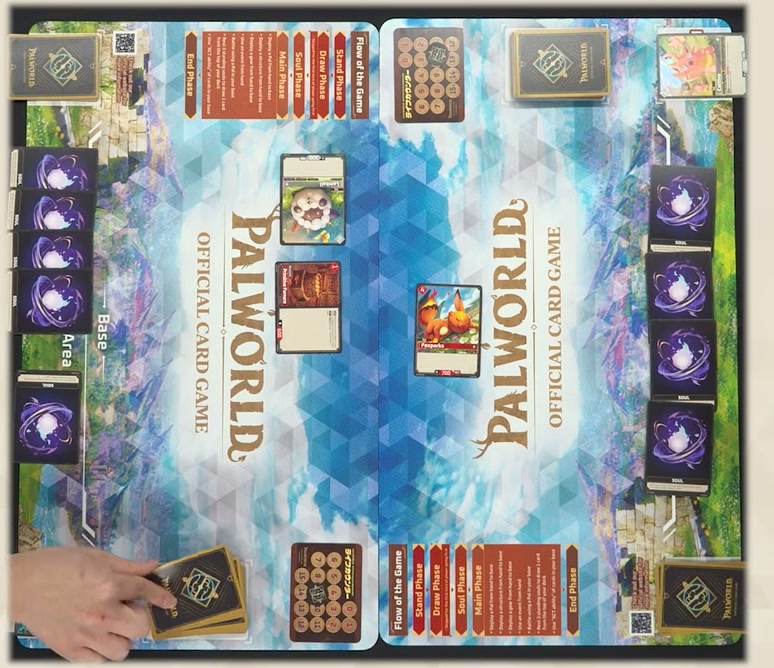
Structure cards (bases and machines) are played in a sideways landscape orientation. They cost Souls like any other card (Cost in the top-left). You may have any number of Structures in play. A Structure has a Durability value and is destroyed if it takes damage equal to or above it.
A Structure's ability is powered by Assigning a Pal to it: Rest one of your Pals and place it to work on the Structure. This triggers the Structure's on-Assign ability. In the video, assigning a Pal to a Structure lets the player draw a card.
Gear
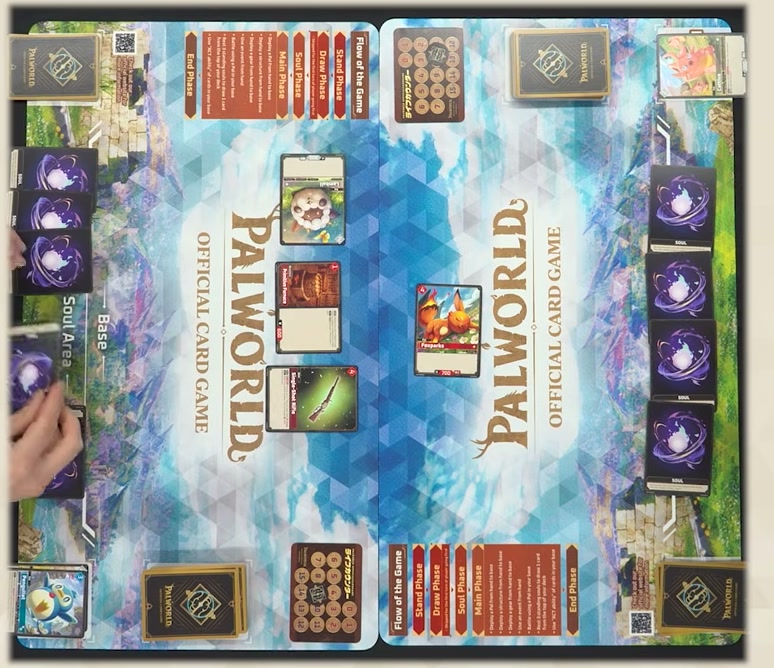
Gear cards (tools and weapons) are played by paying their Cost, just like Pals. Many have an on-deploy ability that fires as they enter play. The video's Single-Shot Rifle deals 1000 damage to an opposing Pal, destroying a Pal with 700 Power.
Costs can also be reduced: a Structure's continuous ability in the video lowers Gear costs by 2, letting a Cost-4 Gear be played for 2.
Winning the game
- Reduce your opponent's life from 10 to 0. Each unblocked, un-canceled point of attack damage costs 1 life.
- An alternative win condition involving destroying an opponent's base structures has been referenced in pre-launch press; full specifics aren't published yet.
Reference
Card stats & keyword glossary
Card types
- Pal Card
- A creature with Power, Strike, Color and (optionally) work suitabilities. Attacks players, Pals or Structures, and can block.
- Gear Card
- Tools and weapons. Pay the Cost to play; often has on-deploy effects.
- Structure Card
- Bases and machines, played in landscape orientation. Powered by Assigning a Pal. Uses Durability in place of Power.
- Soul Card
- Resource cards in the 10-card Soul Deck. Rested to pay Cost.
- Event Card
- One-shot effects. Pay the Cost; the effect resolves; the card goes to the Graveyard. Some Events are Quick.
Card stats
- Cost
- Top-left number. The number of Souls you Rest to play the card.
- Color
- Red, Blue, Green, Purple, or Colorless. Must match your chosen deck colors (Colorless is universal).
- Strike
- Lower-right number. The damage a Pal deals when it attacks a player, and the number of cards the defender reveals on the damage check. Disclosed values: 1–4.
- Power
- Bottom-center number. Used in Pal-vs-Pal battles: both Pals deal their Power to each other, and a Pal is destroyed if it takes damage ≥ its Power. Damage clears at the End Phase. Values come in 100-point increments (e.g. 200 / 300 / 700).
- Lucky (subtype)
- A sparkle icon in the upper-right marks a “Lucky Pal.” If revealed during an opponent's damage check on you, it cancels the damage. Capped at 8 per main deck.
- Durability (Structures)
- Replaces Power on Structure cards; the Structure is destroyed when its Durability is exceeded.
- Rarity
- Base rarities RR, R, U, C. Trial Decks add a guaranteed parallel slot (TSR / TSP).
Ability & status keywords
- AUTO
- Triggered ability. Fires automatically on its trigger (commonly “On Deploy” or “On Assign”).
- ACT
- Activated ability. You choose to use it, often for an added cost.
- CONT
- Continuous/static ability. Always active while in play (e.g. a Structure reducing Gear cost).
- Quick
- Timing keyword. Can be played/activated while you are being attacked, not just on your own turn.
- Stand / Rest
- Standing = upright and ready; Rest = turned sideways and spent. Pals Rest to attack, Assign or block; Souls Rest to pay Cost. Rested cards Stand again in your next Stand Phase.
- Assign
- Resting one of your Pals to “work” a Structure, triggering its on-Assign ability.
Work suitability
The same 12 work-suitability tags from the videogame are referenced by Structure cards as activation requirements. Assign a Pal with the matching tag to power the Structure's effect.
- Watering
- Kindling
- Mining
- Lumbering
- Planting
- Generating
- Handiwork
- Gathering
- Cooling
- Transporting
- Farming
- Medicine